Star Laser Engrave File: A Practical Review for Digital Fabrication
In the rapidly evolving landscape of digital fabrication, the quality of input files often dictates the success of the final output. For creators utilizing laser engraving and cutting machines, the transition from a digital design to a physical object requires precision, high-resolution assets, and an understanding of how different software interprets visual data. The Star Laser Engrave File, available through Creative Fabrica, represents a specific category of digital asset designed to bridge this gap. This review examines the file’s technical specifications, practical applications, compatibility with major industry-standard software, and its overall utility for both professional manufacturers and serious hobbyists.
Understanding the Asset: Format and Specifications
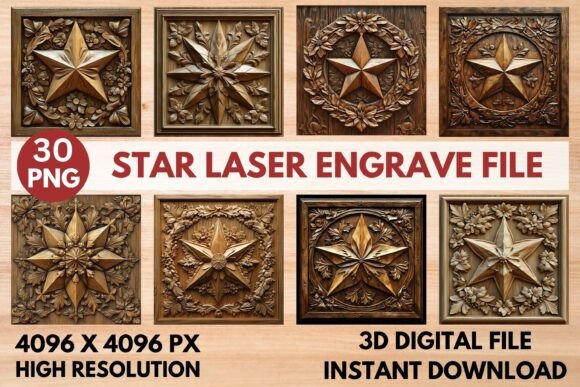
At its core, the Star Laser Engrave File is not a vector cut file in the traditional SVG or DXF sense. It is a raster-based PNG collection optimized specifically for grayscale and color mapping in engraving workflows. The package includes 15 distinct coloring PNGs and 15 corresponding grayscale PNGs, all rendered at a resolution of 4096x4096 pixels. This high resolution is critical for laser engraving, where the machine reads pixel density to determine burn depth and intensity. Lower-resolution images can result in pixelated edges, loss of fine detail, and inconsistent shading when scaled up on larger materials like wood panels or acrylic sheets.
The inclusion of both coloring and grayscale variants offers significant flexibility. Grayscale PNGs are generally preferred for CO2 laser engravers because they allow the machine to vary power automatically based on pixel brightness—a technique known as dithering. Coloring PNGs, while less common for pure monochrome engraving, can be useful for projects requiring specific color layering or when using specialized software that maps hues to different power levels. The transparent background feature ensures that users can place the star design onto any material without unwanted white boxes interfering with the cut or engrave area.
Software Compatibility and Workflow Integration
The true value of the Star Laser Engrave File becomes apparent when integrated into popular laser control software. Two of the most widely used platforms, LightBurn and Glowforge Studio, handle these files differently, and understanding these nuances is essential for achieving professional results.
LightBurn Configuration
For users operating within LightBurn, the recommended approach involves leveraging the grayscale capabilities of the PNG. The file should be imported as a grayscale image to enable the Jarvis dithering filter. Dithering is a process that simulates continuous tone imagery through the use of dots, varying in size or spacing, to create the illusion of shades of gray. When applied correctly, this allows the laser to produce subtle gradients rather than harsh binary black-and-white contrasts. Users should note that the file is non-editable; it is a finished raster graphic intended for direct engraving. Attempting to trace over it to create vector paths may result in unnecessary complexity and potential alignment issues.
Glowforge Settings
Conversely, Glowforge users benefit from the platform’s automated material recognition and power modulation. The provided recommended settings—Speed 1000, Power 90, Grayscale-Vary Power, LPI 270, and a single pass—are calibrated to maximize detail retention on light woods. The "Grayscale-Vary Power" setting is crucial here, as it instructs the machine to adjust the laser’s energy output dynamically based on the darkness of each pixel. This ensures that the central points of the star appear darker and more defined, while the outer edges fade gracefully, creating a three-dimensional effect on flat surfaces.
Material Versatility and Real-World Applications
While the recommended settings focus on light wood, the versatility of the Star Laser Engrave File extends to a variety of other substrates. Acrylic, particularly frosted or clear varieties, responds well to high-resolution grayscale engraving, producing a striking frosted finish against the transparent background. Leather goods, such as journals, wallets, and belts, also serve as excellent canvases for this design, where the contrast between the burned star pattern and the natural grain of the leather adds texture and depth.
The design’s aesthetic makes it suitable for a broad range of commercial and personal projects. In home décor, it can be engraved onto wooden coasters, wall art, or decorative plaques. For stationery and paper crafts, the high resolution ensures crisp lines even on delicate cardstock. Fashion prints and textile transfers can utilize the coloring variants if heat-transfer methods are employed, although care must be taken to ensure the ink adheres properly to the fabric fibers. Packaging designers might find the star motif useful for creating premium unboxing experiences, adding a touch of elegance to product labels or inner boxes.
Evaluating Quality, Consistency, and Limitations
When assessing the quality of digital assets for production, consistency is key. The 4096x4096px resolution provides ample headroom for scaling, allowing users to enlarge the design for large-format projects without significant degradation. However, it is important to acknowledge the limitations inherent to raster files. Unlike vector graphics, which can be scaled infinitely without loss of quality, PNGs have a fixed pixel grid. If the design is enlarged beyond its native resolution, the edges may become jagged or blurry. Therefore, it is advisable to test the file at the desired final size before committing to expensive materials.
Another limitation to consider is the non-editable nature of the file. Users cannot easily change the shape of the star, adjust the number of points, or modify the internal patterns without external image editing software. For those seeking customizable templates, this lack of editability might be a drawback. However, for users who appreciate the specific artistic direction of this particular star design, the trade-off is minimal. The file serves as a polished, ready-to-use asset that saves time in the design phase.
Who Should Consider This File?
The Star Laser Engrave File is best suited for individuals and businesses who prioritize efficiency and high-quality output in their laser projects. Small business owners producing custom gifts, jewelry, or signage will find the file’s versatility valuable. Freelancers and makers who need reliable assets for client work can rely on the consistent performance of the grayscale and coloring options. Educators teaching digital fabrication may also appreciate the file as an example of how raster images interact with laser hardware, demonstrating the importance of resolution and dithering settings.
Conversely, users who primarily engage in vector cutting (e.g., creating intricate puzzle pieces or precise geometric shapes) may find this file less relevant. Since it is strictly an engraving asset, it does not provide cut lines for routers or lasers set to cut-through mode. Additionally, beginners who are still learning the basics of laser calibration might find the recommended settings a helpful starting point, but they should expect to experiment further to achieve optimal results on different materials.
Final Assessment
Overall, the Star Laser Engrave File offers a robust solution for creators looking to add detailed, high-contrast star motifs to their laser projects. Its high resolution, dual-format availability, and compatibility with leading software platforms make it a practical addition to any digital library. While it lacks the editability of vector files, its strength lies in its readiness for immediate use and its ability to produce professional-grade engravings with minimal setup. For those willing to respect the constraints of raster graphics, this asset delivers consistent, stunning results across wood, acrylic, leather, and paper.